|
Crop Common
Name
|
Crop
Species
|
Primary
Pollinating Mechanism(s)
|
Pollinating
system
|
Wild Crossable
Species in US
|
|
Onion |
Allium cepa |
|
|
N
|
|
Garlic |
Allium sativum |
|
|
N
|
|
Garden Chives |
Allium schoenoprasum |
|
|
N
|
|
Garlic Chives |
Allium tuberosum |
|
|
N
|
|
Dill |
Anethum graveolens |
|
|
N
|
|
Celery |
Apium graveolens |
|
|
Y
|
|
Beet |
Beta |
|
|
Y
|
|
Swiss Chard |
Beta |
|
|
Y
|
|
Mustard |
Brassica juncea |
|
|
Y
|
|
Kale |
Brassica napus |
|
|
Y
|
|
Broccoli |
Brassica oleracea |
|
|
N
|
|
Brussels Sprouts |
Brassica oleracea |
|
|
N
|
|
Cabbage |
Brassica oleracea |
|
|
N
|
|
Cauliflower |
Brassica oleracea |
|
|
N
|
|
Collards |
Brassica oleracea |
|
|
N
|
|
Kale |
Brassica oleracea |
|
|
N
|
|
Chinese Cabbage |
Brassica |
|
|
N
|
|
Mustard, Chinese |
Brassica |
|
|
Y
|
|
Turnip |
Brassica |
|
|
Y
|
|
Pepper |
Capsicum annuum |
|
|
N
|
|
|
Chenopodium album |
|
|
Y
|
|
Escarole/ Endive |
Cichorium endivia |
|
|
N
|
|
|
Cichorium intybus |
|
|
Y
|
|
Watermelon |
Citrullus lanatus |
|
|
N
|
|
Cilantro |
Coriandrum sativum |
|
|
N
|
|
|
|
|
|
|
|
Crop Common
Name
|
Crop
Species
|
Primary
Pollinating Mechanism(s)
|
Pollinating
system
|
Wild Crossable
Species in US
|
|
Armenian Cucumber |
Cucumis melo |
|
|
N
|
|
Cantaloupe Melon |
Cucumis melo |
|
|
N
|
|
Honeydew Melon |
Cucumis melo |
|
|
N
|
|
Musk Melon |
Cucumis melo |
|
|
N
|
|
Cucumber |
Cucumis sativus |
|
|
N
|
|
Pumpkin |
Cucurbita pepo |
|
|
Y
|
|
Winter Squash and Show
Pumpkins |
Cucurbita maxima |
|
|
Y
|
|
Winter Squash |
Cucurbita moshata |
|
|
Y
|
|
Summer Squash and Fall Squash
|
Cucurbita pepo |
|
|
Y
|
|
Carrot |
Daucus carota |
|
|
Y
|
|
Arugula |
Eruca sativa |
|
|
N
|
|
Fennel |
Foeniculum vulgare |
|
|
N
|
|
Lettuce |
Lactuca sativa |
|
self #1
|
Y
|
|
Gourds |
Lagenaria siceraria |
|
|
N
|
|
Tomato |
Lycopersicon lycopersicum |
|
self
#1/#2
|
N
|
|
Basil |
Ocimum basilicum |
|
|
N
|
|
Parsley |
Petroselinium crispum |
|
|
N
|
|
Lima Bean |
Phaseolus lanatus |
|
|
N
|
|
Common Bean |
Phaseolus vulgaris |
|
self #1
|
N
|
|
Pea |
Pisum sativum |
|
self #1
|
N
|
|
Radish |
Raphanus sativus |
|
|
Y
|
|
Turkish Eggplant |
Solanum gilo |
|
|
N
|
|
Eggplant |
Solanum melongena |
|
|
N
|
|
Spinach |
Spinacea oleracea |
|
|
N
|
|
Fava Bean |
Vicia faba |
|
|
N
|
|
Cowpea |
Vigna unguiculata |
|
|
N
|
|
Corn |
Zea mays |
|
|
N
|
|
|
|
|
|
|
|
Self
#1: self pollinating species, outcrossing is usually < 1%
|
||||
|
Self
#2: self-pollinating species that often outcross between 2-5%
|
||||
|
Self
#3: self-pollinating species that may cross at rates > 5%
|
||||
Friday, August 11, 2017
Pollinating Mechanisms & Systems in Common Vegetable Crops

Wednesday, March 15, 2017
Luddite Indeed: Monsanto Chicanery And Lies Unveiled
In a litigation case involving Monsanto, a Federal judge has unsealed a cache of documents that clearly show Monsanto buying its research and blocking legislation and rules that would impinge on the sales of their popular weed-killing product, Round Up.
For everyone who has opposed Round Up and Monsanto, this is an almost euphoric moment. We have said all along, the research was flawed, incomplete, inappropriate and inconclusive. Most of the positive research on glyphosate - Round Up's active ingredient - has been done in the US while research in Europe has often contradicted the American work (see this from the World Health Organization, a project of the UN). Now, we know why: Monsanto has spread money through the American research establishment and American Universities! A fact acknowledged for many years and common knowledge among researchers in the biological sciences, to sully Monsanto is a good way to get your funding cut and see your work, along with your reputation, destroyed.
Personally, this vindication is sweet. Having been told "my tinfoil cap" was off kilter, called a Luddite and worse and having my photo used to represent the foolish who fail to embrace the future, I have held that there was truth yet to be uncovered. Boom. Here it is. And I'm just as certain this is just the beginning. Living with Monsanto's creations is NOT the doorway to the future, it is the end of the future.
What other lies have they told us? What else have they had swept under the rug for their profits at the expense of the health of our fellow citizens and the human race?
But beyond that: this is a condemnation of capitalism; the idea that "profit" or making money, completely justifies all else must die. This finite world has a message for capitalists where ever they may be and we all must learn to sustain what there is. Do you see the dichotomy? Supporting "climate change" and ridiculing Monsanto shows the ability to discern "science" done for profit vs.science done for knowledge.
This is a major step in bringing this monster to heel. There is much more work to be done - somehow we must get our institutions back from this Goliath that tramples law, decency, truth, justice and simple honesty.
The one thing I know we can do today, just as I knew it in 2010 is to plant seeds of our food, harvest the food, but save the seeds to plant next year - do not rely on a corporation to maintain your food supply. You think this is hard? Not as hard as believing these lies about the efficacy of Round Up in your food supply, the earth and your body.
And, as they say, you get tomatoes.
david
 |
| In a green bottle no less! |
For everyone who has opposed Round Up and Monsanto, this is an almost euphoric moment. We have said all along, the research was flawed, incomplete, inappropriate and inconclusive. Most of the positive research on glyphosate - Round Up's active ingredient - has been done in the US while research in Europe has often contradicted the American work (see this from the World Health Organization, a project of the UN). Now, we know why: Monsanto has spread money through the American research establishment and American Universities! A fact acknowledged for many years and common knowledge among researchers in the biological sciences, to sully Monsanto is a good way to get your funding cut and see your work, along with your reputation, destroyed.
Personally, this vindication is sweet. Having been told "my tinfoil cap" was off kilter, called a Luddite and worse and having my photo used to represent the foolish who fail to embrace the future, I have held that there was truth yet to be uncovered. Boom. Here it is. And I'm just as certain this is just the beginning. Living with Monsanto's creations is NOT the doorway to the future, it is the end of the future.
What other lies have they told us? What else have they had swept under the rug for their profits at the expense of the health of our fellow citizens and the human race?
But beyond that: this is a condemnation of capitalism; the idea that "profit" or making money, completely justifies all else must die. This finite world has a message for capitalists where ever they may be and we all must learn to sustain what there is. Do you see the dichotomy? Supporting "climate change" and ridiculing Monsanto shows the ability to discern "science" done for profit vs.
This is a major step in bringing this monster to heel. There is much more work to be done - somehow we must get our institutions back from this Goliath that tramples law, decency, truth, justice and simple honesty.
The one thing I know we can do today, just as I knew it in 2010 is to plant seeds of our food, harvest the food, but save the seeds to plant next year - do not rely on a corporation to maintain your food supply. You think this is hard? Not as hard as believing these lies about the efficacy of Round Up in your food supply, the earth and your body.
And, as they say, you get tomatoes.
david
Monday, August 15, 2016
Perfectly Imperfect...
With all the hubbub in Sacramento, we feel the need to reiterate our position and our way of distributing seeds to our members.
You should know that we share seed grown by community members with love and care like our ancestors have done for thousands of years. It may not meet state germination or labeling standards. And it is without a doubt NOT patented seed - we don't want those seeds in our library because it should not be legal to patent life. SOME of our seeds may be OSSI (Organic Seed Saving Initiative, pronounced like your talking about an Australian) and we are proud to state as much. The OSSI pledge: You have the freedom to use these OSSI-Pledged seeds in any way you choose. In return, you pledge not to restrict others’ use of these seeds or their derivatives by patents or other means, and to include this Pledge with any transfer of these seeds or their derivatives.

The Seed Library of Los Angeles tries our best to ensure the quality of our seed using best practices in inventory care and labeling. Nonetheless, seeds are alive and people using the seed library have varying degrees of skill in saving seeds. You should know that you might experience low germination rates or receive seeds that were not properly labeled. This is a volunteer-run project, and we do the best we can with the time and resources we have.
If you do have any problems with the seed you get from the seed library, please let us know so we can try to fix it for future users of the library!

Email us at info@slola.org.
Thanks for your interest in local seeds!
david
Thursday, August 4, 2016
News: Some Good, Some Not So
Let's start with the not-so-good. Last Friday, July 29th, President Obama signed into law a Federal GMO labeling bill. We at the library watch GMO legislation and development closely because pollen spreads and we are adamant that we do not want to grow or eat GMO food until it's been honestly and appropriately tested.
The bill that Obama signed is a travesty - it is the worst possible outcome of all legislation that could have been enacted. The law, in the first place, destroys state laws for labeling - like the perfect reasonable Vermont bill. Vermont's law held food manufacturers to place a simple line, "This item contains GMOs" on the outside of the container. Nothing ambiguous there - and manufacturers were complying.
 |
| A QR code. You need a smartphone and an internet connection. And know how to use it. I do, but do your grandparents? |
The Federal law makes everything massively more complex and renders a foolish and idiotic result. First off, there is no labeling for two years because the Dept of Agriculture needs that time to "study" the problem. Secondly, many GMOs already in our food supply, will not have to be labeled according to this law - things like high-fructose corn syrup. And the label will be in the form of a QR code or an 800 number to further obfuscation.
I have heard a lawsuit against this bill is pending. I hope we get some sanity with some legal reprieve. If not, prepare for wholesale boycotts and other actions to show our dissatisfaction with this horribly flawed law.
On the other hand!
The American Association of Seed Control Officials and the American Seed Trade Association are recommending that seed libraries be exempt from the laws of seed businesses as regulated by state agricultural departments.
The RUSSL (Recommended Uniform State Seed Law) amendment is a groundbreaking document that allows seed libraries to continue operating in the commons without penalty. This means no fees, no germination testing, and no expiration dates. As the name implies, the RUSSL amendment is a recommendation and must be approved legislatively state by state.
 |
| Neil Thapar at Sustainable Economies Law Center, the lone male head in the back on the left, and Betsy Goodman, down in front, founder of the Omaha, NB seed libraries played a very large part in getting this through the AASCO! |
This IS good news, but keep the corks in the champagne for a minute or two more. This is not a law - it is a RECOMMENDATION for future laws. If the law in your state excludes seed libraries from doing what seed libraries do, this changes nothing. BUT, it does mean, when seed saving laws come up for discussion in your state legislatures, this language from the AASCO, will be the language that will be suggested as a place to start. That is big news, but don't roll down to your county ag office with an invitation to swap seeds just yet.
There are so many awesome people to thank for their hard work opposing the distressing Federal law and they deserve to know we value the work they did for us. In CA, Boxer stood with us, while Feinstein defected. And, of course, Obama, who had campaigned FOR labeling, was the biggest let down of all. But we will work to make sure it doesn't stand. GMOs do not play well with other crops - we have seen this contamination cause financial hardship and devastation to organic farms who are held liable for the spread of the patented genes.
We thank Neil Thapar and Betsy Goodman and others for going to the annual meeting of AASCO and asking them to consider our seed libraries.
I did not go because I felt it would be futile. Shows you what I know and shows you what can happen when you do show up! I have a great deal of respect for all these folks that made this happen - it does not change California law, which is still pending, but it's due to come up sometime in August and we'll keep you posted!
david
Wednesday, May 18, 2016
SEED SAVERS' EXCHANGE'S MOST POPULAR SEEDS
Setting up a seed library is a daunting task for anyone – not only are there differing ideas about how it should be set up, the goals that should be aimed for and administration of it all but choosing which seeds go into the library is probably one of the most important parts of a seed library.
 |
| Pods of mesquite stored for seed as we explore the use of mesquite as a stable food crop in the face of Climate Change. |
Like many seed libraries, SLOLA started with a core of a few seeds saved by those of us involved in the founding of the seed library and complemented that with whatever seeds were given to us – many seed companies are generous with their annual culling of leftover seeds. For us, in particular, we were very much indebted to Native Seeds/SEARCH, Renee's Seeds and especially to Baker Creek Seeds. They helped us round out our inventory and allowed us to open for business straight away.
We still accept donations, let me make that clear. But today, we are honing our library and 'pruning' some seeds, while purchasing seeds we feel might better serve us than those we had gotten for free. Our central focus – and our stated goal – is to have most of our seed be returned seed from members who have borrowed from us. This is the essence of the Seed Library of Los Angeles and we continue to preach this to one and all – seeds provided by libraries should eventually be locally grown (therefore more locally adapted) except for some seeds that are just too damn difficult. We have elected to annually purchase onion and parsnip seed, for example, at this point. The seeds are short-lived and we have no one working those plants yet.
You could do a lot worse than choosing to offer Seed Savers' Exchange's most purchased seeds. Let's look at the following list and compare notes:
| Arugula, Arugula* | I am not a big arugula fan, but here in LA, this will naturalize and become an annual harbinger of warmer weather – usually spouting in our garden about the beginning of February. We can find enough of our friends that have arugula seeds stashed in paper bags in their spare bedroom, there is not much worry of this one going away. |
| Beet,Detroit Dark Red* | I love beets, but limiting a library to only Detroit Dark Red might be a crime. The other beets we carry include a mangle (a large beet grown for animal feed in the past), Burpee's Golden (a lower germination rate, but superior taste),Chioggia (also sold as a Bulls Eye beet) and others that are lesser known. Chioggia and the golden beets will not stain like the pure red ones. |
| Carrot, Dragon* | Spot on! This is a good choice – especially when dealing with children. Purple on the outside makes for interesting and delicious eating. |
| Carrot, Red Cored Chantenay* | Also one of my favorites – the standard carrot in my garden. |
| Corn, Golden Bantam | This is truly one of the best corn varieties to grow in a small urban garden. The trick with Golden Bantam is not to let them get too far along. The window of perfection is slim with this one and too old ears are starchy and take some chewing. |
| Cucumber,A & C Pickling | I am not familiar with this variety but every seed library should carry at least one pickling cucumber – they are smaller cucumbers and therefore are perfect for a salad for two, or two salads for one. |
Herb, Cilantro
Herb, Rosemary
Herb, Thyme |
I have grouped all these herbs together because, in LA at least, it is much easier and gets you where you want to go faster, to propagate these plants asexually – from cuttings – rather than from seed. SLOLA does not carry these seeds. These are all perennial herbs. |
| Herb, Genovese Basil | But this is an annual herb and so we do carry basil seeds. SLOLA has backed away from Genovese Basil – there is a basil wilt going around and Genovese seems to be affected by it more than others. If you can grow Genovese, do it! It is the best basil there is. |
| Herb, Parsley Giant from Italy* | This herb is biennial – it's life extending out over two years. It is a worthy contender, SLOLA has Italian Flat Leaf (which I prefer) and a curled leaf variety that I can't even recall. I think that says something. |
| Kale, Dwarf Blue Curled* | I grew this one year. At harvest time, I was kicking myself all over the garden. Yes, it is a good kale. But you get half the harvest of a full sized kale and it takes the same footprint! If you love gourmet kale, go for it. We don't have this one our library. |
| Kale, Lacinato* | This is the kale almost everyone is drawn to, it has a distinctly different leaf and is prolific. We carry this one and probably will always. Kales are tough to save seed from – they are not cooperative about flowering at the same time here and can cross with so many different other veggies, this is one we'll continue to buy. |
| Lettuce, Seed Savers Mixture* | If you are getting lettuce seeds from SLOLA, you won't find any mixtures. We like to keep our lettuces straight. Although I plant different varieties together, I choose them specifically based on time of year and what I want the lettuce for. Often I am mixing Drunken Woman Frizzy Head with Mantilia which is a green butterhead variety. I set out baby plants in a pleasing pattern and the contrast between the two is astounding – they also look dynamite in a salad bowl. |
| Pea, Amish Snap* | This is a great snap pea and I can see why it's one of their best sellers. It is a climber though, so if you need a smaller plant, forego Amish Snap and look for a bush pea in our collection. |
| Pepper, Jalapeno Traveler Strain | Only one pepper??? I'm sure there are many devotees that are just a little hurt. This is, of course, one of THE most popular peppers grown in gardens all across the states. I have grown it and it is a good pepper – although I can get by with no more than 10 hot peppers in a year. SSE doesn't list any sweet peppers in their top 24, but I'd throw in Marconi and maybe Torno di Toro as well. |
| Spinach, America* | I totally agree with America Spinach – vs the old standard Bloomsdale's Long Standing, which may be long-standing, but the crinkled leaves are hell to free dirt and debris from. America, with a very agreeable flavor, is as productive but has smooth leaves which take a lot less time (and water!) to clean. Hands down, skip Bloomsdale's. |
| Squash, Black Beauty Zucchini | I think Black Beauty is responsible for my reluctance to like zucchini. So productive! You turn your back on it for 25 seconds and that cute little zuke you were just admiring, is now the size of Godzilla and twice as forbidding. I would MUCH RATHER go for a better tasting, less productive variety like a French or Lebanese type (i.e. Cocozelle or Lebanese White Bush), light green and much more susceptible to bruising, you rarely find these in markets, even farmers' markets. We have been using Genovese Summer Squash as our standard for seed saving – this year will be our second annual Polli-Party where we illustrate how to ensure no crossing in your squashes saved for seed. |
| Squash, Golden Zucchini | This is a better pick than Black Beauty, but it's not going to be on my list anytime soon. Also, make sure you don't get any variety of squash that is more susceptible to Powdery Mildew which is rampant in any garden that gets ocean influence or in an enclosed garden in which the air circulation is limited. |
| Squash, Waltham Butternut | This is a great winter squash – with a hard skin for storage until winter. It is, however, also a very large plant. Keep that in mind when choosing. Almost all winter squashes have that problem, though. This is a large squash, plan on freezing half or three-quarters when you do cut into it. The plant itself will wander around under other plants – and act as a kind of living mulch to protect your soil if managed diligently. |
| Swiss Chard, Five Color Silverbeet* | The standard of colorful chards. I have no problem with this choice. It will be hard, for seed savers over the years to maintain the five colors. It seems like most of my chards are now red veined with only an occasional pink, white or orange showing up. |
| Tomato, Amish Paste | This is certainly a good tomato! I know they took the sales figures to make up this list, but how on earth could you reduce all those tomatoes to just two? This would certainly be a must on my list along with about 30 others! |
| Tomato, Italian Heirloom | I'm not familiar with this variety – guess I'll be planting some soon! |
| Watermelon, Oh So Sweet | Because of the Powdery Mildew mentioned earlier, I have not even tried to grow melons in my garden for over 15 years. Even though I love watermelons and grew many as a child in KS, I'm no longer the authority I was when I was eight. I'm glad others can grow them! |
Please note that SLOLA's inventory sheets are divided between warm and cool season – therefore, not all these seeds are available all the time. An asterisk (*) denotes cool season, the others are, by default, warm season.
It is important to look for varieties that grow well in your own garden. SLOLA has planned for our two branches to have different inventories to serve the different climate zones. We agreed in the beginning to use Sunset's Western Garden Guide as our reference on climate. SLOLA Venice serves primarily Zones 22 and 24 while the San Fernando Valley branch is composed of gardeners in zones18 and 19. If you are not familiar with Sunset's zones, get familiar with them ASAP. They are much more specific than the USDA's zones which cover all of the US and only go up to 10, 11 or 12 depending on which version of their map you see. SFV people can grow melons and winter squash much easier than we can in Venice with our ocean influence. They also can grow better tomatoes – and the larger tomatoes too.
Combining this list with others, the Slow Food movement's Ark of Taste, for example, SLOLA hopes to broaden our initial seed inventory into a cornucopia of what will do well in Southern California and teach our members how to save these seeds to build stewardship and develop the agriculture we need in LA. We have tried to reach into our communities and find locally adapted seeds that have been grown here already, but have found very few so far. That doesn't mean they aren't there! I hope that SLOLA continues to work to make our library more inclusive.
We have started to change the loss of genetic diversity in our food. Join in, learn one variety and agree to steward that variety. Learn all you can about it and grow it out for a few years. Learn how to save it and share your results with others.
Save a seed, build a community. We welcome you!
david
Monday, December 28, 2015
Criteria for Saving The BEST Seed
Make that saving the 'best' seed.
It came to my attention recently that we have had a lot of talk about how to save seeds and how to store them and all sorts of hard data like that, but we have totally ignored any criteria for saving seeds, like which seeds from which plant versus a different plant. How do you decide which is the best plant to save seed from?
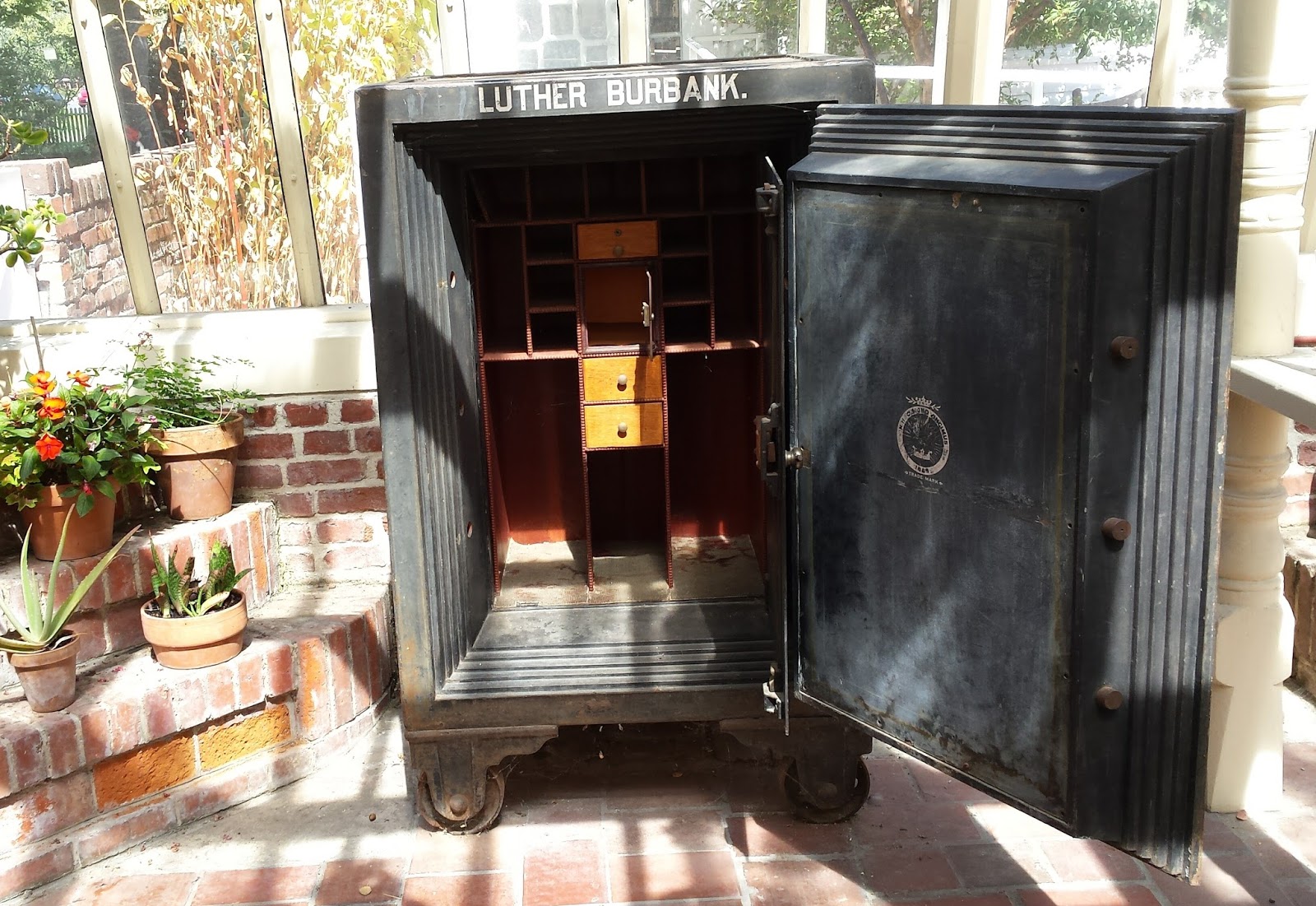 |
| Luther Burbank's safe in his green house. He was serious about saving his seeds! |
This has been made all the more nerve-wracking when combined with a multitude of exhortations that all seed savers are plant breeders based on their selection of which seed to save. This needs to be demystified.
Yes, all seed savers are seed 'breeders.' It is true that by saving any given seed over this other seed, you are choosing the pattern of the plants of the future But this is not a one-shot deal, if you select for a specific trait – the criteria that is the basis for selection in one year will not make a difference in the big picture.
Selecting for one trait must occur over many generations in order to breed for that trait. Plants grown in Southern California and selected year after year for the biggest producer will become, after years of selecting, will become the variety of "bigger producers in Southern California." But this is not a single year phenomenon. It takes many generations to achieve this. If you're not a patient sort, I might suggest a different hobby or vocation.
If you are just trying to keep a stable variety and not select for this or that, you need to save seed from a population of plants that will express many different genetic variations to gather as much of the natural diversity of the variety. Population sizes (of different individual plants) differ according to species. If you are saving seeds for the seed library, you don't have to be rigorous because we will combine your seeds with others of the same variety increasing the population size.
For example, in broccoli, a minimum of thirty plants is supposed to be the absolute lowest number of plants to choose your seeds from. But if you save seeds from 9 plants and someone else saves seeds from 8 plants and someone else saves seed from 13, you have the 30 plant minimum. (Ideally we will go beyond the minimum population size.)
This is one reason we think we'll always be buying in corn seed. The minimum population for maintaining corn vigor is 200 plants. If you have to grow 200 plants to save seed, how many must you grow to have something to eat???? In our urban gardens, that doesn't make sense. Unless SLOLA finds a field where we can plant corn and harvest from 200 plants (that's just for ONE variety - what if we want a popcorn, a yellow corn, a white corn and a grinding corn? That would be 800 plants at the MINIMUM! Frowny face.)
Most plants are somewhere in the middle as far as population size goes. Don't worry about most of them too much - corn is the extreme example of a plant that absolutely goes bonkers if the population sizes are too low.
Saving seeds from the self-pollinating plants (beans, tomatoes, lettuce, peas) is always very easy. You know, because they pollinated themselves, who 'mommy' and 'daddy' both are. In plants that are not self-pollinated you do not have the assurance who 'daddy' is. The squash you eat will come with Mom's genetics, but the seed in that squash will be a cross between the mother and the father plants.
That's why non-selfing plants are a bit harder, taking a bit more patience and some more observation. However, it is not difficult or arduous. The key is patience and observation and you can breed all kinds of plants - SLOLA, by the way, hopes to have a lot of one day workshops to show how to save seeds from diverse gardens - one plant, or one pollination method at a time - easy bite sized pieces.
Carrots, beets, chard, radishes and turnips are easy to save seeds from because they go to seed in their second year (now there's a drawback for you!). They are biennials (take two years). It's uncommonly rare that a plant stays alive to the second year in a cared-for garden; they form their roots in the first year and that's what we eat so a second year carrot or beet is a rare thing indeed. With carrots, the only drawback one must be concerned with is flowering Queen Anne's Lace which is also called 'wild carrot.' But without one of those around, you can save your carrot seed with abandon.
Which plants would you choose for seed or would you just try to save a bunch?
On a tour of Luther Burbank's garden, we were shown varieties of wheat. He had one named Prolific and another named Delicious. One produced a lot of wheat - and if that was your goal, you had your wheat - but if you were looking for quality over quantity, you took Delicious. So you CAN select for more than one trait, just not in the same field!
What is the BEST seed? You decide. There are some guidelines and you'll get them from a SLOLA member or a book; with some plants the first seeds are the most vigorous, in others not so much. Do you want it to be an early or a late? Of big beefy and juicy? Or a small and succulent edible part that holds for a long time?
I'll repeat, when saving a variety save some seed from a bunch of different specimens that show the range of variation in the plants. And for most of us, this is the point of our saving seeds - to keep a variety that we know and love and to preserve it for future generations.
The most important thing is to learn to save seeds. If you save some seeds, no matter how you selected them, you have taken a gigantic step towards freedom for you, your family and your friends on what they eat and how it's grown.
There is nothing more important than that.
david
Subscribe to:
Posts (Atom)